
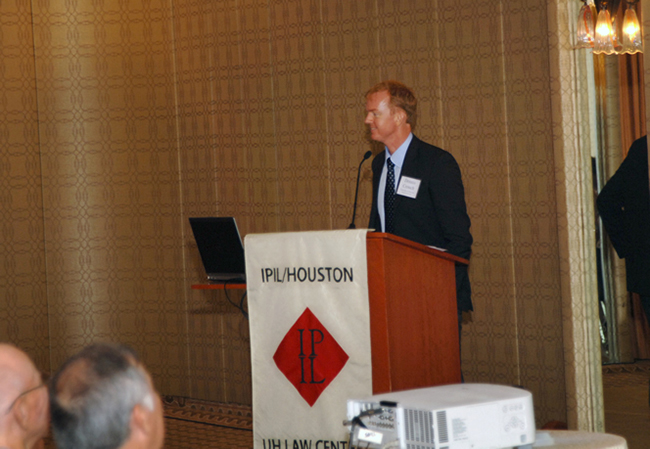
 Photo credit: University of Houston Law Center
WHEN it comes to software patents, the US is no longer the place to be. China might be it and as the EPO mimics China -- as disturbing as that may be also in the human rights aspect -- patent law firms now openly say that it's easier to get (and/or defend) software patents in Europe than it is in the US.
"...patent law firms now openly say that it's easier to get (and/or defend) software patents in Europe than it is in the US."Over the past 3 years we have been writing a lot about Alice -- the Supreme Court (SCOTUS) decision that ended a lot of software patents in the US. For software patents to withstand a court's scrutiny (the higher, the harder) has become the exception rather than the norm. The Court of Appeals for the Federal Circuit (CAFC) has just reaffirmed this position (late on Friday). There is still no sign -- however remote -- that SCOTUS will revisit a case like Alice, but sites like Watchtroll work hard lobbying for such a thing to happen. We last gave an example of that approximately one week ago. Just escalated up to SCOTUS were a bunch of cases that involve no software patents at all; there was also Sandoz v Amgen. Managing IP wrote that "[o]n April 26, the US Supreme Court got its first chance to hear arguments over the biosimilars patent dance."
"Over the past 3 years we have been writing a lot about Alice -- the Supreme Court (SCOTUS) decision that ended a lot of software patents in the US."This case is important, but it doesn't concern us because we tend to focus on abstract patents.
Meanwhile, at CAFC, it has become "more difficult for a patentee to obtain injunctive relief even after winning its infringement lawsuit," Patently-O asserts. To quote:
The court here appears to shift this from a four-factor test to a four-element test. The result of this decision is that it becomes incrementally even more difficult for a patentee to obtain injunctive relief even after winning its infringement lawsuit and defending against validity challenges. I also expect that any analysis of the historical equitable factors (the approach suggested by eBay) will recognize that this holding is incorrect.
"When it comes to CAFC, Patently-O's founder (Crouch) is still eager to slow things down."But this is the exception, not the norm. Crouch should amend his headline and 'remand'... ;-)
Meanwhile, the Supreme Court gets mentioned by Patently-O in relation to CAFC's dismissal of appeals. Parasites that can't stop throwing crappy software patents at the system (even after Alice) are wasting everybody's time and Patently-O continues to object by saying:
Certainly, if the PTAB had issued its judgment without opinion, the Federal Circuit would have immediately vacated that decision. However, the appellate court suggests that the rules of opinion writing should not be self applied.
"The Federal Circuit (CAFC) has very limited resources, so dealing with thousands of appeals in an exhaustive fashion, e.g. with written determinations, would be impractical."CAFC has far more important matters to look after. For instance, here is a new "report" from IAM that deals with the famous MedCo v Mylan case:
The Federal Circuit has reversed a decision that Mylan Inc’s proposed generic version of a drug infringed one of two patents owned by the Medicines Company (MedCo v Mylan, Fed Cir 2017). In doing so, it revised the district court’s claim construction to import a non-limiting example from the specification to define the pivotal term – ‘efficient mixing’ – based on its determination that the example provided the “only clear delineation” of the “scope of the term”.
"Perhaps the moral of this whole story is that we need to protect PTAB's functionality and allow CAFC to deal with oppositions quickly enough, typically reaffirming PTAB's decision to invalidate (about 80% of the time, based on last year's and this year's statistics)."Another new IAM "report", this one about the Canadian Supreme Court and Canada's CIPO, says that the Canadian "Patent Office instructs examiners to disregard Supreme Court precedent..."
So it's more or less like the USPTO, which continues to grant some software patents in spite of Alice, necessitating further scrutiny by PTAB or the courts (which typically invalidate these pretty quickly).
Perhaps the moral of this whole story is that we need to protect PTAB's functionality and allow CAFC to deal with oppositions quickly enough, typically reaffirming PTAB's decision to invalidate (about 80% of the time, based on last year's and this year's statistics).
"The demise of software patents is essential for the wellbeing of the US software industry, the businesses which actually employ programmers (except those who just prey on successful companies by suing them with software patents, e.g. IBM and Microsoft)."It's not hard to understand why Patently-O keeps meddling and interfering in these processes. Just look who's running the blog. It's not an entirely objective person (far from it, yet he called his blog "the nation's leading patent law blog"). The articles are vastly dominated by authors with law degrees and no industrial experience.
Citing the America Invents Act (AIA, which brought PTAB), here is Patently-O bemoaning CBM (covered business method) reviews. Just because patents on business methods are coming under growing scrutiny in the United States doesn't mean there's some injustice; quite the contrary. The US is finally -- if not belatedly -- cracking down on overpatenting (the same thing which happens at the EPO under Battistelli right now). Apparently the EFF has already weighed in as follows:
Two additional amicus briefs have also been filed supporting the petition. EFF argues (1) that the panel decision contorts the statutory text; and (2) ignored the consideration of deference to an agency’s interpretation of its governing statute. Clearing House Payments Company and Financial Services Roundtable joined together and argue (1) CBM institution rates are alredy down; and (2) the case allows artful claim drafting to effectively avoid CBM. (The artful drafting issue is largely moot since CBM will sunset in September 2020).
The key here is interpretation of Section 18(d)(1) of the America Invents Act that limits the scope of Covered Business Method Reviews to patents “that claim[] a method or corresponding apparatus for performing data processing or other operations used in the practice, administration, or management of a financial product or service.” Does the statute require that the claim include the financial product or service use? Note here that the argument is not based upon a statute codified in the United States Code since it is only a temporary provision that will sunset after three more years.