
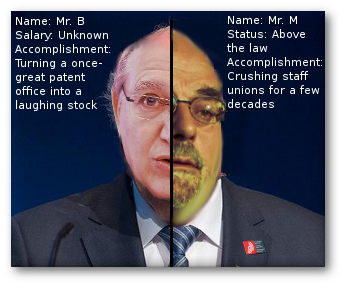
Rumours are swirling regarding the EPO's President, Mr. Battistelli, as we last noted last night. Some rumours suggest that it all boils down to money, at least for Battistelli. "Further rumours," said this one comment from last night is that "[i]n order to go, BB wants 18 millions €. Furthermore, Mrs Bergot should be allowed to remain in a high position. If true, it would be a shame. Someone who has destroyed the proper functioning of a model organisation and made a mess of the social climate should go with a kick in the lower back, not with money taken from the fees paid by the users. No negotiations, please! He and the crooks who supported him all along should simply go."
“Someone who has destroyed the proper functioning of a model organisation and made a mess of the social climate should go with a kick in the lower back, not with money taken from the fees paid by the users.”
--AnonymousAround 700 people from the EPO went to protest, told us another person about Wednesday's protest in Munich (against their employer, notably Battistelli). Information which Techrights received, moreover, serves to confirm there's a major confrontation between Battistelli and the Administrative Council. The exact nature of it is still unknown.
The "news from the EPO," as one person put it in a message to us, involves Guillaume Minnoye as well. "This is what I heard about the demo in Munich," said the source. "With close to 700 persons, the demo went well (although there were less people than at the previous demos). SUEPO invited the Board 28 to talk to the protesters, but they didn't.
"Guillaume Minnoye (EPO VP1) said during a meeting today that there is a proposal to be voted on in the Administrative Council's (AC) March meeting. The proposal is apparently not from the EPO president. He expects a confrontation between the president and the AC."
In the mean time, given a little more time to breathe, we decided to retrieve this ILO judgment (we've made a local copy of the official English translation, as PDF, just in case) which shows Minnoye, the head of Internal Services at the time (according to a source of ours), attacking SUEPO even two decades ago. In the following text we highlight the role played by Minnoye at the time:
Registry's translation, the French text alone being authoritative.
EIGHTY-FIRST SESSION
In re BAILLET,
CERVANTES and COOK (No. 3)
Judgment 1547
THE ADMINISTRATIVE TRIBUNAL,
Considering the complaint filed by Mr. Bernard Jean Raymond Baillet against the European Patent Organisation (EPO) on 6 January 1995, the EPO's reply of 27 March, the complainant's rejoinder of 2 May and the Organisation's surrejoinder of 6 June 1995;
Considering the complaint filed by Mr. Jean-Pierre Cervantes against the EPO on 6 January 1995, the Organisation's reply of 27 March, the complainant's rejoinder of 29 June and the EPO's surrejoinder of 3 August 1995;
Considering the third complaint against the Organisation filed by Mr. Steven Derek Cook on 6 January 1995, the EPO's reply of 27 March, the complainant's rejoinder of 28 June and the Organisation's surrejoinder of 2 August 1995;
Considering Articles II, paragraph 5, and VII of the Statute of the Tribunal;
Having examined the written submissions and disallowed the application by Mr. Cervantes for hearings;
Considering that the facts of the case and the pleadings may be summed up as follows:
A.The EPO employs the complainants as patent examiners at grade A3 in its Directorate-General 1 (DG1) at The Hague. Mr. Cervantes is chairman of the local section of the Staff Union (SUEPO) of the European Patent Office, which is the EPO's secretariat. On 15 October 1992 the union used the Office's internal messenger service to send each of its members at The Hague an invitation to attend a general meeting on EPO premises on 20 October at 11 a.m. Not all the invitations were delivered: Mr. Baillet and Mr. Cook did not get them.
In a note dated 19 October 1992 the head of Internal Services told Mr. Cervantes that the Office would not be helping to distribute the invitations because union meetings were not allowed in the "core" period of the working day, between 10 and 11.30 a.m.
By a letter of 14 January 1993 Mr. Cervantes asked the President of the Office to declare the note "invalid" and to make sure that mail was properly delivered in future. By letters of 15 January Mr. Baillet, Mr. Cook and other members of the union asked the President to declare "unjustified" what they described as the "censoring" of their private mail, to promise that the Administration would not intercept it again and, if he refused, to treat their letters as internal appeals.
The President upheld the decision and the case went to the Appeals Committee. In a report dated 4 July 1994 the Committee recommended rejection. By letters of 11 October 1994 the Director of Staff Policy informed the complainants that the President had endorsed the Committee's recommendation. Those are the decisions they are impugning.
B.The complainants plead breach of Article 30 of the Service Regulations, which reads:
"Permanent employees shall enjoy freedom of association; they may in particular be members of trade unions or staff associations of European civil servants."
Mr. Baillet says that by intercepting private mail from the staff union the Administration was guilty of censorship and acted ultra vires. Mr. Cervantes argues from precedent that to allow only "approved" communication betweenunion members is to deny freedom of association. What the EPO did hampered freedom of speech and betrayed the Administration's resolve to cripple the union.
The complainants see the EPO's behaviour as a departure from usage. Mr. Cook observes that the Office had always allowed staff associations and social clubs unrestricted use of the messenger service. The complainants plead discrimination on the grounds that others had their invitations delivered.
Questioning the impartiality of one member of the Appeals Committee, they charge the Organisation with breach of Article 111 of the Service Regulations.
They want the Tribunal to set aside the President's decisions of 11 October 1994.
Mr. Baillet invites it to condemn "censorship" at the EPO and award him 5,000 German marks in moral damages and another 5,000 marks in damages for the "mishandling" of his case by the Appeals Committee.
Mr. Cervantes asks that it order the President to "stop censoring union mail" and award him 10,000 marks on that account, one mark for the flaw in the Committee's proceedings and 10,000 marks in costs. As president of SUEPO he seeks a further 85,600 marks in damages for moral injury to the union.
Mr. Cook seeks an award of at least 20,000 guilders in moral damages, including 10,000 for breach of Article 111. He claims at least 3,000 guilders in costs.
C.In its replies the EPO argues that the complaints are irreceivable because the complainants suffered no injury: its action made no "real" impact on union business or on freedom of association.
In subsidiary argument on the merits the Organisation says it is under no duty to distribute private mail, let alone unsealed messages that are against the rules. In any event it did not bar timely announcement of the meeting on the union's notice board or holding the meeting as scheduled.
The EPO denies breach of Article 111: had the impartiality of any member of the Committee been in doubt the staff representatives might have objected. In fact the Committee's recommendation was unanimous.
Mr. Cervantes' tirade against the Administration's treatment of the union is "mistaken" and "uncalled-for". Besides, he has no locus standi to claim damages on the union's behalf.
D.In their rejoinders the complainants challenge allegations of fact in the replies and press their claims. Again they express doubts about the impartiality of one member of the Appeals Committee.
Citing Judgment 1269 (in re Errani), Mr. Cervantes submits that as the union's "representative" he may seek damages on its behalf.
Mr. Cook gives examples of staff meetings held in the core period with support from the EPO.
E.In its surrejoinders the EPO enlarges on its pleas and comments on issues raised in the rejoinders. It maintains that the letters were unlawful insofar as they contained invitations to a union meeting to be held in working hours. It is the Appeals Committee, not the Administration, that decides under Article 111 whether to exclude a member whose impartiality is in doubt.
In the surrejoinder on Mr. Cook's case the EPO maintains that it may allow a meeting even in working hours if the organisers have applied for and got permission: SUEPO did not.
CONSIDERATIONS:
The facts
1.The three complaints are about the right of members of the Staff Union of the European Patent Office (SUEPO) to have union notices delivered.
2.On 15 October 1992 Mr. Cervantes, as chairman of SUEPO, sent out invitations to all members to attend a general meeting on 20 October 1992 at 11 a.m. in a room on EPO premises at The Hague. The messenger service
delivered the invitations in the main building but not elsewhere. Mr. Baillet and Mr. Cook did not get them. By a letter of 19 October 1992 the head of Internal Services, who was in charge of the distribution of mail, told Mr. Cervantes that the Office would not be delivering the invitations. On 14 and 15 January 1993 the complainants sent letters of protest to the President of the Office. Letters of 19 January 1993 told them that the President was upholding the decision, and letters of 4 and 5 March that he was putting the cases to the Appeals Committee.
On 4 July 1994 the Committee recommended rejection. The President rejected the appeals by decisions of 11 October 1994, the ones now under challenge.
Joinder
3.The Organisation applies for joinder. Since the complaints raise the same issues of fact and of law the application is allowed.
Receivability
4.The EPO objects that the complaints disclose no cause of action and are therefore irreceivable.
5.It observes that Mr. Cervantes, who purports to be acting for the union, may not claim damages on its behalf; he may act only in his own name; and his interest in obtaining a promise of delivery of union mail is academic.
6.The purpose of Mr. Cervantes in bringing his complaint is to obtain the quashing of the President's decision of 11 October 1994 to reject his appeal of 14 January 1993. One plea in support of his internal appeal was that by refusing to deliver the "individual and private invitations" he had sent out the EPO was in breach of his rights as its employee. And the claims he puts to the Tribunal are plain enough: he wants it to declare the Organisation out of order and reaffirm his freedom of speech, particularly on matters of union business. He also believes that intercepting messages from the union was a breach of the freedom of association that Article 30 of the Service Regulations guarantees for everyone in the EPO's employ. The conclusion is that it is wrong to say he is acting for the union: he has brought his complaint in his own name; and he has a direct and rightful interest in the observance of freedom of association that Article 30 requires.
7.The EPO's general objection to receivability is that the complainants show no cause of action. It is saying that it has committed no breach in fact or in law of their freedom of association or right to carry on union business. In its submission the union has no right to its help in delivering union messages; the complainants, as members of the union, have no greater rights than the union itself and no right to the delivery of private mail by the Organisation; and they have suffered no discernible injury since what the EPO did had no real effect on union business or on freedom of association.
8.Precedent has it that an organisation has some latitude in affording facilities to a staff union and its decisions are not subject to judicial review. That is not so, however, where it is charged with breach of freedom of association. The Tribunal will indeed interfere if the effect of the impugned decision is to hamper the freedom of speech that any union must enjoy. Refusal to deliver invitations to a union meeting is unquestionably a breach of the privacy of mail and of the freedom of speech that is part and parcel of freedom of association. The EPO's pleas that the union had no right to delivery and that no injury was caused go rather to merits than to receivability. The conclusion is that because the complainants seek a ruling on the lawfulness of refusal to deliver union mail and because such refusal is actionable the objection to receivability must fail.
The membership of the Appeals Committee
9.A preliminary issue is the complainants' objections to one member of the Appeals Committee. They cite Article 111 of the Service Regulations: the impartiality of any member may be challenged whenever he is "required to take part in a case in which he might have a personal interest or in respect of which he participated in preparing the decision under appeal ...". They contend that Mr. G. Schwabe should not have sat on the Committee because he was in charge of the distribution unit; the President's decision was one of direct concern to that unit and while the case was pending Mr. Schwabe was asked to draft rules on the use of the messenger service.
10.The plea fails. It is plain from the text that the guidelines that Mr. Schwabe drew up on the handling of mail are general in purport: they are not about the particular case of union mail, and they say that at each duty station mail may be processed to suit local circumstances. Besides, the Committee reported on 4 July 1994, whereas the guidelines did not go out until 29 August 1994, and it is by no means sure that they were written by the earlier date.
The Committee's members - including the staff representatives - were of one mind in rejecting the charges of partiality against Mr. Schwabe.
The merits
11.The gist of the complainants' case in support of their claims to the quashing of the impugned decisions is breach of Article 30 of the Service Regulations, which is quoted in B above. They see the interception of the invitations as bare censorship and part of a policy of the EPO's to curb the union. The Organisation's answer is that the mail was neither "personal" nor even "individual and private invitations" but "unsealed announcements of a meeting", the same for everyone and no mystery. Besides, having concluded no agreement with the Organisation for the purpose the union has no right to have it deliver a summons to such a meeting.
12.The notices were not private mail but invitations sent to each of the complainants by name to attend a general meeting. To be sure, the EPO had no formal agreement with the union about facilities such as the distribution of a summons to a meeting. But it admitted to the Appeals Committee that its consistent practice since 1992 had been to distribute any unsealed unofficial internal mail, whether private or not, save any text containing a personal attack on someone. Was such usage binding in law? As Judgment 421 (in re Haghgou) said, for example, a usage will be binding if staff have come to rely on it.
13.The plain expectation of the staff was that the EPO would deliver notices from their union without let or hindrance. The Organisation does not deny the practice, but just pleads limits to it: the union's invitations offended against the rule that a general meeting must be held outside core working hours.
14.Yet the EPO did not treat the offence - the holding of the meeting as scheduled - as serious enough to constitute an abuse: in the event it authorised the meeting at the time announced and imposed on those who attended neither any penalty nor even the obligation to make up the time spent off work. Besides, by thwarting the delivery of union notices to staff outside the main building the EPO denied some, and not others, the freedom of association they were guaranteed by Article 30. It thereby discriminated against them. The conclusion is that the complaints must succeed.
15.The claim by Mr. Cervantes to an award of damages to the union is irreceivable because his complaint is in his own name. And though the individual claims by the three complainants are formally sound, the amounts they claim cannot be awarded: the meeting did take place and there is no evidence of any particular injury. Each is awarded 500 German marks in damages for moral injury.
16.Having won their case, they are entitled to costs, and the Tribunal awards them 500 marks each. Their other claims are dismissed.
DECISION:
For the above reasons,
1.The President's decision of 11 October 1994 is set aside.
2.The EPO shall pay each complainant 500 German marks in moral damages.
3.It shall pay each complainant a further 500 marks in costs.
4.Their other claims are dismissed.
In witness of this judgment Sir William Douglas, President of the Tribunal, Mr. Edilbert Razafindralambo, Judge, and Mr. Jean-François Egli, Judge, sign below, as do I, Allan Gardner, Registrar. Delivered in public in Geneva on 11 July 1996.
(Signed)
William Douglas E. Razafindralambo Egli A.B. Gardner
Updated by PFR. Approved by CC. Last update: 7 July 2000.
Comments
katkatkat
2016-02-20 13:23:07
Dr. Roy Schestowitz
2016-02-21 23:39:14
katkatkat
2016-02-20 06:01:50